
Ovarian endometrioma: when to monitor and when to discuss surgery
Key Takeaways
An ovarian endometrioma is not automatically removed before IVF. Routine surgery has not been shown to improve live birth and may reduce ovarian reserve; surgery can still be discussed for significant pain, atypical imaging or difficult follicle access. Cyst size alone does not decide the plan.
Key evidence: ESHRE guideline on endometriosis Endometrioma surgery before assisted reproduction Ovarian reserve after endometrioma surgery
Finding an ovarian endometrioma during an IVF assessment can raise a practical question: will you need an operation before treatment can start? The cyst does not automatically need to be removed.
The ESHRE guideline advises against routine surgery before IVF solely to improve live birth. The decision depends on what surgery could help with in your case, alongside its possible effect on ovarian reserve.
What is an ovarian endometrioma?
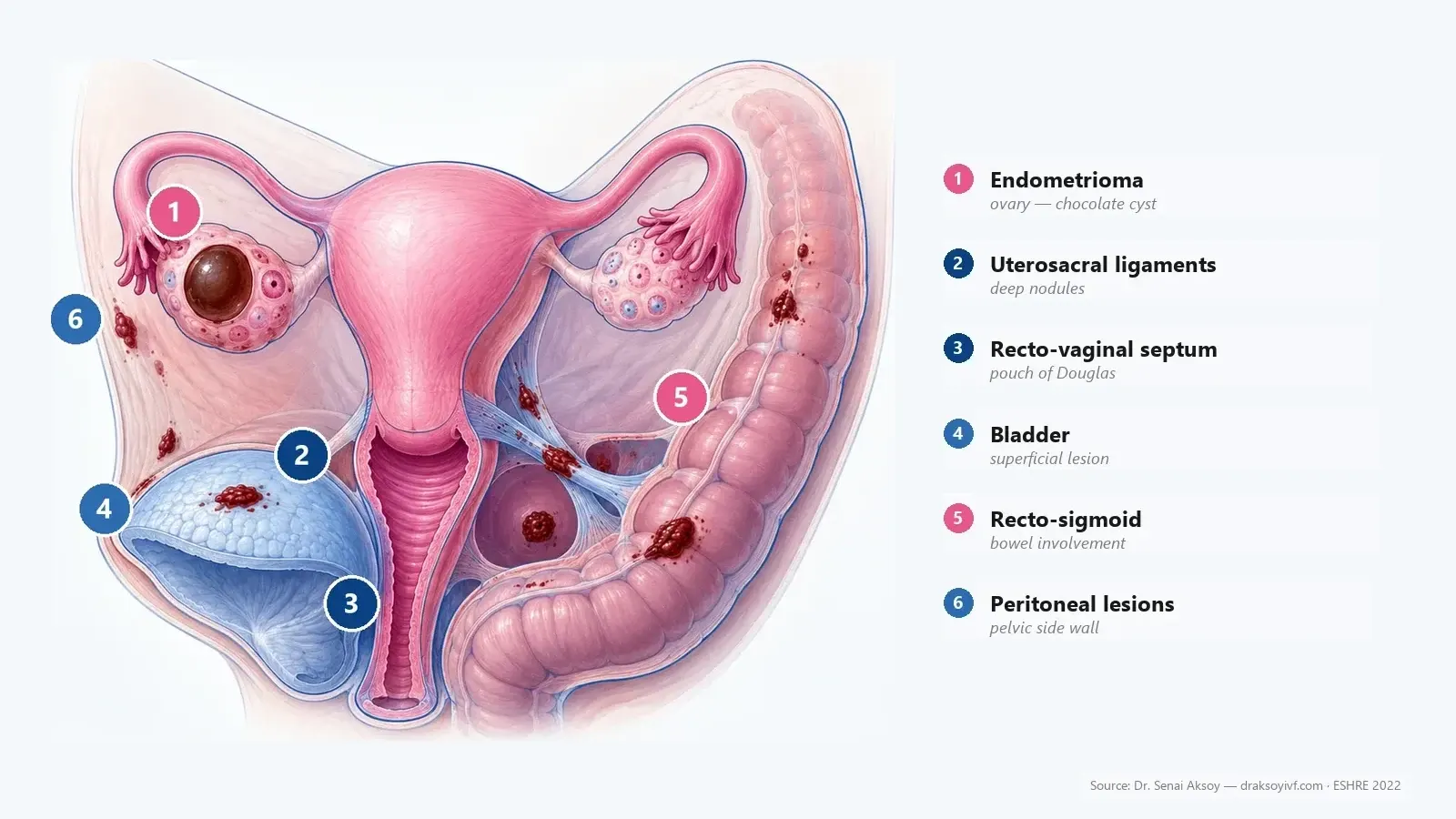
An endometrioma is a cyst that forms when endometriosis affects the ovary. It contains old blood, which explains the name “chocolate cyst”. It may be found during a scan for pain or fertility difficulties, but some people have no symptoms.
For the wider context, see our guides to endometriosis, endometriosis and infertility and endometriosis surgery.
A cyst with a typical, stable ultrasound appearance may allow a different plan from one that has unusual features, causes significant pain or makes egg collection difficult.
When can monitoring be reasonable?
Monitoring may be reasonable when:
- the appearance is typical and remains stable;
- pain is absent or manageable with an agreed plan;
- there is no immediate concern about a complication or an atypical mass; and
- the endometrioma does not prevent safe access to the follicles needed for treatment.
Size alone does not decide whether you need surgery before IVF. A larger cyst may make egg collection more difficult. Your symptoms, scans, age, ovarian reserve and treatment plans help determine when the next check is needed.
When should surgery be discussed?
Surgery may be discussed for persistent pain despite appropriate treatment, unusual scan findings, a complication or difficult access to the follicles during egg collection. Follicles are the small fluid-filled sacs in the ovary that contain developing eggs. The purpose of an operation should be clear before it is planned.
The ESHRE guideline does not recommend routine surgery for an ovarian endometrioma before assisted reproduction solely to improve live-birth outcomes. It does recognise that surgery can be considered for pain or to improve access to follicles.
Sudden, severe pelvic pain needs urgent medical assessment. A complication such as a twisted ovary or a ruptured cyst needs to be considered rather than waiting for your next routine scan (NHS guidance on ovarian cyst symptoms).
What do atypical scan findings mean?
Unusual scan findings do not, on their own, mean cancer. They can include a solid area with blood flow, projections into the cyst or irregular internal walls. A change from previous scans may also need a closer look.
The ESGO/ISUOG/IOTA/ESGE consensus on ovarian masses supports specialist ultrasound assessment. MRI may help if ultrasound leaves the nature of the cyst unclear; it is not an automatic next step for every endometrioma.
CA-125 is a blood marker that can be raised in endometriosis. The same consensus on imaging and blood markers explains its limitations: one result cannot reliably diagnose or rule out cancer. It must be interpreted alongside the scan and clinical assessment.
How can surgery affect ovarian reserve?
Removing the cyst wall, called cystectomy, can also remove or damage healthy ovarian tissue. In the 2012 meta-analysis by Raffi et al., the pooled analysis of 237 patients found an average fall in AMH of about 1.13 ng/mL after cystectomy. Results varied substantially between studies, so this average cannot predict your individual change.
AMH (anti-Müllerian hormone) is a marker of ovarian reserve, not an exact count of remaining eggs or a direct measure of egg quality. The ASRM guidance on ovarian reserve tests explains why it needs to be read alongside age and the antral follicle count, which counts small follicles on ultrasound. A low AMH result alone does not mean IVF will fail.
The 2012 review by Somigliana et al. also found lower AMH after surgery in most of the studies it examined, with a greater decline when both ovaries were operated on.
The cyst itself may also be associated with lower AMH. The 2018 meta-analysis by Muzii et al. compared patients with unoperated endometriomas with patients without endometriomas. This association does not prove that removing the cyst will improve ovarian reserve.
Does removing an endometrioma improve IVF success?
Routine removal has not been shown to improve the chance of a live birth with IVF. This lack of demonstrated benefit, together with the risk to ovarian reserve, explains the ESHRE recommendation against routine pre-IVF surgery.
The 2015 systematic review by Hamdan et al. did not find a statistically significant difference in live birth between patients who had surgery before IVF/ICSI and those who did not. Most included studies were retrospective, meaning treatment was not randomly assigned. The findings do not establish that both approaches are equivalent for every patient.
Pain, unusual scan findings and difficult follicle access remain separate reasons to discuss surgery.
What about fertility preservation before surgery?
Egg freezing may be worth discussing if endometriosis affects a large amount of ovarian tissue, particularly in both ovaries. The discussion should cover your age, ovarian reserve, previous operations, the likely number of eggs that could be collected and the time available before surgery.
The ESHRE guideline recommends discussing the benefits and limits of fertility preservation in extensive ovarian endometriosis. Its eventual benefit remains uncertain. It is not a required step, and no number of frozen eggs guarantees a future birth.
Does the surgical technique matter?
Yes. If surgery is chosen, ask how the surgeon will treat the cyst while limiting damage to healthy tissue. Cystectomy removes the cyst wall; other techniques destroy its lining in place. The choice depends on the cyst, previous surgery, the reason for treatment and the risk of recurrence.
The ESHRE surgical recommendations stress the need to minimise ovarian damage. Ask how healthy tissue will be protected and how heat used to control bleeding will be limited. No single technique is ideal for every patient.
Can an endometrioma return after surgery?
Yes. Recurrence is possible, and the risk varies with the extent of endometriosis, whether one or both ovaries are involved, previous treatment and follow-up time. Exact percentages should not be applied to an individual without considering those factors.
For people who are not trying to conceive immediately, prolonged hormonal treatment may reduce recurrence and pain. The ESHRE guideline supports discussing postoperative hormonal treatment when pregnancy is not being pursued right away. It is not a substitute for an individual fertility plan.
When both ovaries are affected, protecting ovarian tissue becomes especially important. The review by Somigliana et al. found a greater AMH decline after surgery on both ovaries. This supports discussing the reason for the operation and how damage will be limited; it does not predict one person’s outcome.
Dr. Aksoy’s approach
Dr. Senai Aksoy explains that an endometrioma alone is not a reason for routine surgery before IVF. He considers pain, unusual scan findings, access to follicles, ovarian reserve and previous surgery together. When surgery has no clear clinical benefit, protecting the remaining ovarian tissue is the priority.
Summary of the clinical input recorded on 1 August 2026.
A practical consultation checklist
Before deciding on surveillance or surgery, ask:
- Does the scan look typical, and has it changed?
- What is the reason for considering surgery: pain, imaging, complication or follicle access?
- What are my AMH and antral follicle count, and how should they be interpreted in context?
- Could surgery affect the amount of healthy ovarian tissue?
- If both ovaries are involved, what is the tissue-sparing plan?
- If I am not trying to conceive immediately, would hormonal treatment be appropriate?
Frequently asked questions
Does every endometrioma need to be removed before IVF?
No. Routine surgery has not been shown to improve live birth before IVF. Surgery may still be discussed for significant pain, atypical imaging, complications or difficult follicle access.
Is a 4 cm endometrioma always operated on?
No. There is no universal size rule. The scan appearance, symptoms, ovarian reserve and treatment plan matter more than a single measurement.
Can an endometrioma lower AMH?
AMH may be lower in some people with endometriomas, and surgery can also reduce AMH. The result needs to be interpreted with antral follicle count, age, previous surgery and whether both ovaries are affected.
Should I freeze eggs before endometrioma surgery?
It may be worth discussing when surgery is likely to affect ovarian tissue, particularly in extensive or bilateral disease. It is not an automatic requirement, and the possible benefit remains uncertain.
Can an endometrioma come back after surgery?
Yes. Recurrence is possible. Follow-up and, when appropriate, hormonal treatment can be discussed according to the fertility timeline.
Sources
- Becker CM, Bokor A, Heikinheimo O, et al. ESHRE guideline: endometriosis. Human Reproduction Open 2022;2022(2):hoac009. DOI: 10.1093/hropen/hoac009.
- Hamdan M, Dunselman G, Li TC, Cheong Y. The impact of endometrioma on IVF/ICSI outcomes: a systematic review and meta-analysis. Human Reproduction Update 2015;21(6):809–825. DOI: 10.1093/humupd/dmv035.
- Raffi F, Metwally M, Amer S. The impact of excision of ovarian endometrioma on ovarian reserve: a systematic review and meta-analysis. The Journal of Clinical Endocrinology & Metabolism 2012;97(9):3146–3154. DOI: 10.1210/jc.2012-1558.
- Somigliana E, Berlanda N, Benaglia L, et al. Surgical excision of endometriomas and ovarian reserve: a systematic review on serum antimüllerian hormone level modifications. Fertility and Sterility 2012;98(6):1531–1538. DOI: 10.1016/j.fertnstert.2012.08.009.
- Muzii L, Di Tucci C, Di Feliciantonio M, et al. Antimüllerian hormone is reduced in the presence of ovarian endometriomas: a systematic review and meta-analysis. Fertility and Sterility 2018;110(5):932–940.e1. DOI: 10.1016/j.fertnstert.2018.06.025.
- Timmerman D, Planchamp F, Bourne T, et al. ESGO/ISUOG/IOTA/ESGE Consensus Statement on preoperative diagnosis of ovarian tumors. Ultrasound in Obstetrics & Gynecology 2021;58(1):148–168. DOI: 10.1002/uog.23635.
- Practice Committee of the American Society for Reproductive Medicine. Testing and interpreting measures of ovarian reserve: a committee opinion. Fertility and Sterility 2020;114(6):1151–1157. DOI: 10.1016/j.fertnstert.2020.09.134.
- NHS. Ovarian cyst: symptoms and urgent warning signs. Patient information, accessed 12 September 2026.
Add as a Preferred Source on Google
You can add draksoyivf.com as one of your preferred health information sources on Google.

The content has been created by Dr. Senai Aksoy and medically approved.