
Failed IVF: What to Review Before the Next Cycle
Key Takeaways
After a failed IVF cycle, review the ovarian response, fertilisation, embryo development, transfer record and uterine factors before deciding what comes next. One unsuccessful transfer often reflects biological variation; repeated failures may justify selected tests and changes to the treatment plan.
Key evidence: ESHRE Good Practice Recommendations on Recurrent Implantation Failure (2023) ASRM Committee Opinion on Fertility Evaluation (2021)
Failed IVF: What to Review Before the Next Cycle

A negative pregnancy test after IVF can be hard to absorb. After weeks of injections, appointments and waiting, sadness, anger or sheer exhaustion are understandable responses. The result is not evidence that you did something wrong.
It is natural to want an answer straight away, or to start another cycle as soon as possible. Yet one unsuccessful cycle rarely has a single, certain explanation. It can still provide useful clinical information. The ESHRE recommendations on recurrent implantation failure support reviewing the treatment step by step before deciding whether to repeat the plan, adjust it or pause.
Start With a Structured Cycle Debriefing
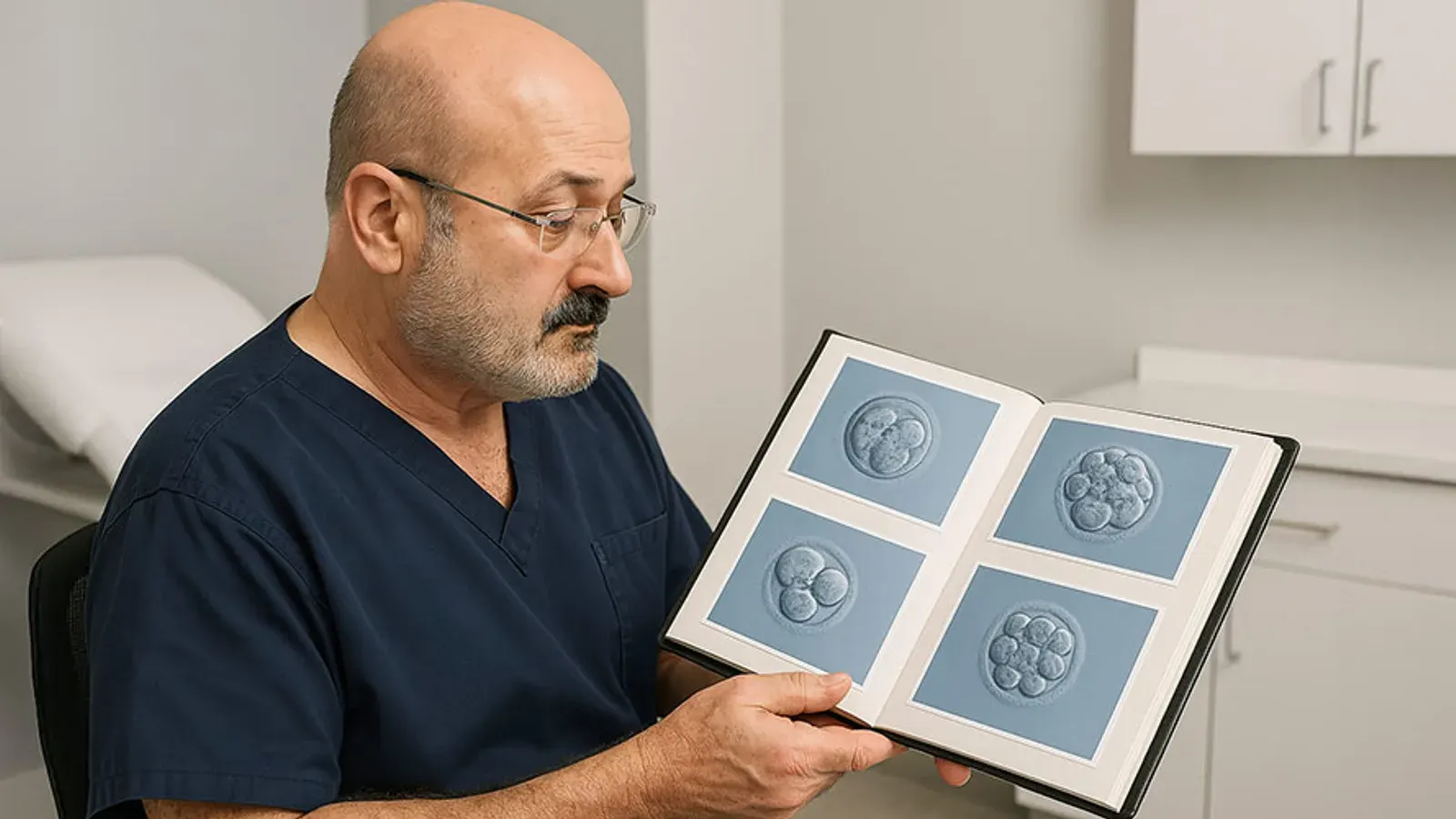
A useful follow-up appointment looks at each stage of the cycle in turn. This is more informative than treating the result as one unexplained event:
- Ovarian stimulation and response: Did the ovaries recruit an appropriate cohort of follicles relative to your age, anti-Müllerian hormone (AMH) level, and antral follicle count?
- Egg collection and maturity: What percentage of retrieved oocytes were at the mature metaphase II (MII) stage?
- Fertilisation: Was the fertilisation rate in the expected range with conventional IVF or intracytoplasmic sperm injection (ICSI)?
- Embryo development: Did the embryos reach the blastocyst stage by Day 5 or Day 6? Which were available for transfer or freezing, and what did their grading show? If PGT-A was used, how should its result be read alongside the rest of the cycle?
- Transfer and uterine factors: Was the transfer straightforward? What did the notes record about the catheter, ultrasound guidance and endometrium?
This review helps separate expected biological variation from a finding that may change the next plan.
Five Critical Questions to Ask After a Negative Result
At the follow-up appointment, five questions can help make the next step clearer.
1. Were the Ovarian Response and Trigger Timing Appropriate?
If egg yield was clearly lower than expected, the team can review the dose, medication choice and trigger timing. A very high response raises the risk of ovarian hyperstimulation syndrome (OHSS); in selected cases, the safer plan may be to freeze the embryos and transfer later.
2. What Did the Laboratory Report Show?
A low fertilisation rate or early embryo arrest before Day 3 may relate to the egg, the sperm or laboratory conditions. Between Day 3 and Day 5, the embryo begins relying more on its own genome, so genetic contributions from both egg and sperm become relevant.
3. Was the Male Partner Assessed Adequately?
Standard semen analysis assesses concentration, movement and shape, but it does not answer every question about sperm. After failed assisted-reproduction cycles, the amended AUA/ASRM Male Infertility Guideline recommends evaluating the male partner. Karyotyping or sperm DNA fragmentation testing may then be considered in context; neither is an automatic test after one failed transfer.
4. Was the Uterine Cavity Assessed Adequately?
The review should ask whether the uterine cavity has been assessed adequately. Polyps, cavity-distorting fibroids, adhesions or a uterine septum may matter, but the appropriate test depends on the history and previous imaging.
A communicating hydrosalpinx can reduce implantation, pregnancy and delivery rates. The ASRM committee opinion on tubal surgery reports rates about 50% lower in affected groups and recommends discussing salpingectomy or tubal occlusion before IVF when appropriate. Surgery still has risks, so this is an individual decision rather than a routine response to every failed cycle.
5. Was the Endometrial Preparation and Transfer Timing Well-Matched?
For frozen embryo transfer, preparation may use a natural, stimulated or programmed cycle. There is no single best protocol for everyone. What matters is whether the chosen plan suited the patient and whether progesterone exposure and transfer timing were aligned.
When Is Additional Testing Truly Helpful?
Further tests should answer a specific clinical question. Not every test offered after an unsuccessful cycle has been shown to help.
Selected tests may be useful when there is a repeated pattern or a clear reason for concern:
- Uterine-cavity assessment: Saline sonography, three-dimensional ultrasound or hysteroscopy may be considered when the history or imaging suggests a cavity problem. Routine screening hysteroscopy is not an IVF add-on for everyone.
- Parental karyotyping: This may be considered when repeated losses, abnormal semen findings or the wider history raises concern about a chromosomal rearrangement.
- Antiphospholipid testing: This belongs mainly in an assessment for recurrent pregnancy loss or thrombosis. Broad screening for inherited thrombophilia is not routine after implantation failure.
- Assessment for chronic endometritis: Endometrial biopsy with CD138 staining may be considered in selected recurrent cases, but diagnostic thresholds are not standardised and evidence that treatment improves outcomes remains limited.
By contrast, broad immune panels, receptivity tests and other unproven add-ons may add cost and anxiety without a demonstrated live-birth benefit. The ESHRE add-ons recommendations explain which tests and treatments should not be used routinely.
Single Failed Cycle vs. Recurrent Failure: How Decisions Differ
A single unsuccessful transfer and repeated implantation failure are not the same clinical situation. Keeping that distinction clear helps avoid both false reassurance and unnecessary testing.
When Repeating the Plan Makes Sense
A single failed transfer—even with a high-grade blastocyst—does not by itself point to a rare disorder. Embryo potential varies with age, embryo biology and whether the outcome is measured per transfer, per retrieval or cumulatively.
If the cycle review finds no clear problem, repeating a broadly similar plan may be reasonable. That choice should reflect age, ovarian reserve, the number and type of embryos available, treatment burden and the couple’s priorities.
When Strategy Needs to Change
A larger change to the plan may be reasonable when:
- Ovarian stimulation yielded few or immature eggs despite adequate reserve.
- Fertilisation was unexpectedly low and the laboratory review identifies a reason to change the insemination plan.
- Embryos repeatedly arrest before reaching the blastocyst stage.
- The number of good-quality blastocyst transfers without implantation exceeds what would be expected for that patient’s individual cumulative chance; the 2026 ASRM opinion advises against using one fixed transfer count for everyone.
- The review identifies an untreated problem involving the uterine cavity, fallopian tubes or endometrium.
Practical Steps to Prepare for Your Next Consultation
Before attending your follow-up appointment, gather your complete treatment records:
- Request the full embryology report: It should record the egg count, maturity, fertilisation rate and Day 3 or Day 5 embryo grades.
- Review the stimulation chart: Note the medication doses, hormone levels and leading follicle sizes at trigger.
- Read the transfer note: Check the catheter type, ease of entry, ultrasound guidance and endometrial thickness.
- Discuss timing, not just treatment: There is no universal rule requiring a one- or two-month delay. Recovery from complications, further tests and emotional readiness may all shape the timing.
If treatment in another country is part of your planning, our guide to IVF in Turkey for international patients explains records, travel and continuity-of-care questions to consider.
Clinical Note
When an IVF cycle does not succeed, the most important medical principle is to replace speculation with systematic analysis. A single negative result is often a statistical hurdle rather than a biological barrier.
We examine the cycle from stimulation to transfer like a chain of individual links. If one link underperformed, we modify it. If every parameter was optimal, we reassure the couple and proceed with confidence rather than subjecting them to battery testing without clear evidence.
— Dr. Senai Aksoy
Frequently Asked Questions
Does one failed IVF cycle mean I will never get pregnant?
No. One failed cycle does not establish a permanent barrier or predict the outcome of every later attempt. It may reflect embryo biology, treatment factors or ordinary statistical variation; sometimes no single cause can be identified.
Should I change clinics immediately after a failed cycle?
Not necessarily. If your team shares the embryology data, reviews the cycle with you and explains any proposed changes, staying with the same clinic can preserve continuity of care. A second opinion may help when the explanation remains unclear or the same plan is repeated without a clear reason.
Is PGT-A recommended after an IVF failure?
Not routinely. The ASRM committee opinion on PGT-A says that a live-birth benefit for routine use has not been demonstrated. It may be discussed for selected patients, but it cannot prove why a previous embryo failed to implant or diagnose a uterine cause.
How long should we wait before starting another cycle?
There is no single interval that suits everyone. Some patients can proceed in the next cycle; others need time for ovarian recovery, treatment of a complication, further investigation or emotional rest. The timing should follow a clinical review rather than a fixed calendar rule.
Sources
- Cimadomo D, Craciunas L, Vermeulen N, Vomstein K, Toth B; ESHRE Working Group on Recurrent Implantation Failure. ESHRE good practice recommendations on recurrent implantation failure. Human Reproduction Open. 2023;2023(3):hoad023. PubMed · DOI
- Practice Committee of the American Society for Reproductive Medicine. Recurrent implantation failure: a committee opinion. Fertility and Sterility. 2026. ASRM
- Practice Committee of the American Society for Reproductive Medicine. The use of preimplantation genetic testing for aneuploidy: a committee opinion. Fertility and Sterility. 2024;122:421-434. ASRM
- Practice Committee of the American Society for Reproductive Medicine. Fertility evaluation of infertile women: a committee opinion. Fertility and Sterility. 2021;116(5):1255-1265. PubMed · DOI
- Practice Committee of the American Society for Reproductive Medicine. Role of tubal surgery in the era of assisted reproductive technology: a committee opinion. Fertility and Sterility. 2021;115(5):1143-1150. ASRM · DOI
- American Urological Association and American Society for Reproductive Medicine. Diagnosis and treatment of infertility in men: AUA/ASRM guideline. 2020; amended 2024. Guideline PDF
- Lundin K, Bentzen JG, Bozdag G, et al. ESHRE good practice recommendations on add-ons in IVF. Human Reproduction. 2023;38(11):2062-2080. PubMed · DOI
Add as a Preferred Source on Google
You can add draksoyivf.com as one of your preferred health information sources on Google.

The content has been created by Dr. Senai Aksoy and medically approved.