
Fresh vs Frozen Embryo Transfer: Which Fits Your IVF Cycle?

Key Takeaways
Neither fresh nor frozen embryo transfer is universally better. A freeze-all strategy is especially useful when OHSS risk is high, PGT is planned, or the stimulation cycle is not suitable for transfer. Fresh transfer can remain a reasonable option when response, progesterone, and endometrium are favorable; in low-prognosis patients, recent randomized evidence found lower live birth rates with routine freeze-all than with fresh transfer.
Key evidence: ESHRE ovarian stimulation guideline (2025) Cochrane review of fresh versus frozen transfer (2021) Low-prognosis randomised trial (2025)
Fresh vs Frozen Embryo Transfer (FET): Which Option Fits Your Cycle?
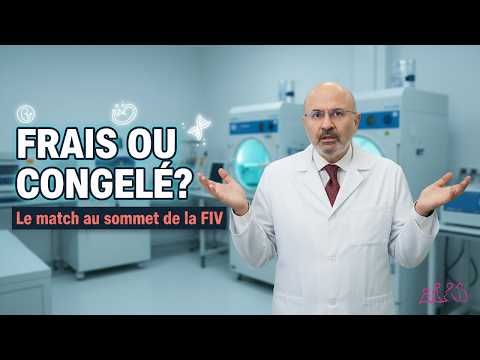
This video is in French. Check YouTube player settings for available translated audio tracks or subtitles.
During IVF, patients often hear two opposite messages: that a fresh transfer is more “natural”, or that a frozen transfer is more advanced and therefore better. Neither shortcut tells the whole story.
A fresh transfer places an embryo in the uterus a few days after egg retrieval. A frozen embryo transfer (FET) uses an embryo that has been vitrified and is transferred in a later cycle. The difference is not simply the date: the hormonal setting, safety considerations, laboratory plan, and reason for waiting all matter.
A more useful question is: what are we trying to solve in this particular cycle? Ovarian response, ovarian hyperstimulation syndrome (OHSS) risk, progesterone timing, the endometrium, embryo testing, and the number of available embryos all help answer it.
On this page:
- Understand the three decisions
- When fresh transfer may fit
- When freeze-all has a clear purpose
- What the evidence says about success
- How a later FET cycle is prepared
- Questions to take into the consultation
Fresh transfer, FET, and freeze-all are three different decisions
A fresh transfer happens in the egg-retrieval cycle. FET happens later. “Freeze-all” is the decision to postpone transfer and vitrify every suitable embryo from that retrieval; it is not the name of every frozen transfer.
| Decision point | Fresh transfer | Frozen embryo transfer |
|---|---|---|
| Timing | Same stimulation cycle as egg retrieval | A later natural, modified-natural, or programmed cycle |
| Hormonal setting | Endometrium is exposed to stimulation hormones | Stimulation and transfer are separated |
| OHSS | An early pregnancy can prolong or worsen OHSS | Freeze-all allows recovery before pregnancy |
| PGT | Usually not compatible with the time needed for results | Commonly used while biopsy results are pending |
| Time and steps | Faster route to the first pregnancy test | Adds freezing, storage, thawing, and another cycle |
Vitrification has made embryo freezing and warming reliable in experienced laboratories. It is still a biological process, not a guarantee. When only one or two embryos are available, even a small risk that an embryo will not survive warming may matter more in the decision.
When a fresh transfer can be reasonable
Fresh transfer can be a sensible option when the stimulation response is controlled, OHSS risk is low, the endometrium and progesterone timing are suitable, and there is no reason to wait for testing or treatment.
A fresh transfer may remain appropriate when:
- the ovarian response is controlled rather than excessive;
- OHSS risk is low;
- progesterone has not risen prematurely;
- the endometrium appears suitable;
- PGT is not planned; and
- there is no uterine or medical reason to postpone pregnancy.
Fresh transfer deserves particular consideration when the prognosis is low or only a small number of embryos is expected. In a 2025 randomised trial of 838 women with low prognosis, live birth after the first transfer was 32% with freeze-all and 40% with fresh transfer. Cumulative live birth was also lower with freeze-all: 44% versus 51%.
Those figures do not predict an individual patient’s result. They do, however, challenge the idea that routine freezing is harmless or automatically beneficial when there is no clear indication.
When freezing all embryos may be useful
Freeze-all is most useful when delaying pregnancy addresses a safety, laboratory, endometrial, uterine, or medical concern.
A freeze-all strategy is often chosen for a defined clinical reason rather than as a default. Common reasons include:
- high ovarian response or a meaningful risk of OHSS;
- an early progesterone rise or an endometrium that is not suitable for transfer;
- PGT, because the embryo is usually vitrified while results are processed;
- a uterine finding that should be assessed or treated first;
- an acute medical issue that makes pregnancy inadvisable in the current cycle; or
- a practical need to separate retrieval and transfer.
The safety indication deserves particular attention. The 2025 ESHRE ovarian stimulation guideline recommends freeze-all to reduce late-onset OHSS risk. A Cochrane review of randomised studies also found substantially less OHSS with freeze-all, while finding little or no difference in cumulative ongoing pregnancy or live birth across the broader IVF population.
PGT
Embryo biopsy results are usually not available in time for a fresh transfer. Suitable embryos are therefore vitrified while the result is processed. Here, freezing is part of the laboratory pathway rather than a claim that frozen transfer is inherently more successful.
PCOS, a high response, and OHSS risk
PCOS can increase the chance of a high ovarian response, but the diagnosis alone does not make freeze-all compulsory. The actual response and the patient’s OHSS risk matter. In a younger patient with a high ovarian response and a clinically meaningful risk, avoiding an immediate pregnancy can prevent late OHSS from developing or becoming more severe.
Endometriosis
Endometriosis also requires a case-by-case decision. A later transfer may be useful when there is a separate reason to postpone pregnancy or when the endometrial and inflammatory context needs attention first. This is not the same as recommending freeze-all or prolonged medical pretreatment for every patient with endometriosis.
Clinical Note
“When vitrification became reliable, there was a period when routine frozen transfer was expected to improve results by allowing better endometrial preparation. Later studies, and what we observed in practice, did not show a universal advantage. We therefore do not offer freeze-all to everyone. We use it when there is a clear reason: for PGT; for women with PCOS or young high responders at risk of OHSS; and for selected patients with endometriosis when transfer should be delayed while the endometrial and inflammatory context is addressed. OHSS should not be underestimated; it can be serious and very burdensome. For patients at meaningful risk, freezing all embryos is an important safety strategy.”
— Dr. Senai Aksoy, first-hand clinical observation originally verified 14 July and reconfirmed 25 August 2026
This is a clinical practice observation, not proof that every patient with endometriosis benefits from freeze-all or medical pretreatment. A meta-analysis of six retrospective studies reported more live births after frozen than fresh transfer in women with endometriosis, but the authors described the evidence as limited and called for randomised trials. The ESHRE endometriosis guideline does not recommend routine prolonged GnRH-agonist or progestogen pretreatment solely to improve live birth because the benefit remains uncertain. Timing and treatment should therefore be chosen for the individual patient, not applied as a standard endometriosis protocol.
Does freeze-all improve the chance of a baby?
Not for everyone. Freeze-all can make treatment safer in a high-risk cycle, but it does not reliably raise cumulative live birth across the general IVF population.
The Cochrane review, based on eight randomised studies and 4,712 women for the cumulative outcome, found that freeze-all probably makes little or no difference to cumulative ongoing pregnancy or live birth. It also delays the first transfer and therefore the time to pregnancy.
The E-Freeze randomised trial likewise found no evidence that routine freeze-all improved the healthy baby rate. The trial enrolled fewer participants than planned and had substantial non-adherence, so it does not settle every subgroup question.
Results can vary by patient group. Earlier trials in selected good-prognosis, ovulatory patients found higher live birth after frozen single-blastocyst transfer. More recent evidence in low-prognosis patients points in the opposite direction. These findings are not contradictory once the populations are considered: they show why a universal “frozen is better” rule is unreliable.
Age, embryo competence, the number of transferable embryos, and laboratory performance remain major determinants of outcome. Published IVF success rates are most useful as population information. They are not a personal forecast.
If FET is chosen, the preparation protocol is a second decision
A frozen embryo can be transferred in a natural, modified-natural, or programmed cycle. The right option depends on ovulation, medical history, monitoring, and practical constraints; current trials do not support one universal protocol for every ovulatory patient.
FET can be performed in a natural ovulatory cycle, a modified-natural cycle with an ovulation trigger, or a programmed cycle using estrogen and progesterone. These approaches do not create the same hormonal environment.
A systematic review of observational evidence linked programmed cycles, in which there may be no corpus luteum, with more hypertensive disorders of pregnancy than natural-cycle FET. The evidence on reproductive outcomes is less settled.
A 2025 open-label trial reported more live births with a strategy starting in a natural cycle, but substantial crossover between groups limited certainty. A multicentre randomised trial published in June 2026 found similar clinical pregnancy rates with fetal heartbeat after natural- and artificial-cycle preparation. It was not designed to establish a difference in live birth.
A larger 2026 BMJ randomised trial assigned 4,376 ovulatory women to natural-ovulation or programmed preparation. Healthy live birth rates were similar (41.6% versus 40.6%), while several maternal complications were less frequent with the natural-ovulation regimen. Cycle cancellation was more common in that group, so protocol choice still involves trade-offs.
These studies answer a different question from “fresh or frozen?” Protocol choice should be discussed only after the decision to use FET has been made. Our guide to endometrial preparation for FET explains the natural, modified-natural, and programmed options in more detail.
Pregnancy and newborn outcomes
Both approaches have reassuring outcomes overall, but their population-level risk patterns are not identical. Neither can be labelled simply “safer” in every situation.
Fresh and frozen transfer have different population-level patterns, not a simple safe-versus-unsafe ranking. A 2024 systematic review of neonatal outcomes found that fresh transfer was associated with more preterm birth, low birth weight, and small-for-gestational-age birth. FET was associated with more large-for-gestational-age birth and macrosomia. The review did not find a significant difference in congenital anomalies or neonatal death.
Some of the higher hypertensive risk reported after FET may relate to the preparation protocol rather than freezing itself. Much of this evidence is observational. It can show an association, but it cannot prove that the transfer method alone caused the outcome. Personal risks such as age, blood pressure, metabolic health, and the FET protocol still need to be considered.
Timing, cost, and international planning
Fresh transfer is usually faster. Freeze-all adds another cycle and may add cost or travel, although the pause can sometimes make recovery and scheduling easier.
Fresh transfer can shorten the path to the first pregnancy test. Freeze-all adds laboratory freezing, storage, warming, medication or monitoring in another cycle, and usually an additional visit. These steps may add cost and emotional burden. For some people, the extra wait is a minor inconvenience. For others, it is one of the hardest parts of the plan and deserves to be discussed openly.
For international patients, a later FET may simplify recovery after egg retrieval or create a more predictable transfer window, but it can also require a second trip. The medical indication should be decided first; travel planning should then support that plan rather than determine it.
Questions to discuss before deciding
A useful consultation should explain why transfer is being done now or later, what evidence applies to the patient’s situation, and what each option changes beyond the pregnancy rate.
Before choosing fresh transfer or freeze-all, ask:
- Is my response high enough to create a clinically important OHSS risk?
- Are progesterone and the endometrium suitable for transfer now?
- Is PGT planned, and when will the result be available?
- How many embryos are likely to be available for transfer or freezing?
- If FET is planned, am I a candidate for a natural or modified-natural cycle?
- What will each option change in time, medication, visits, and cost?
The plan may change as the stimulation cycle unfolds. That is not a failure of planning; it is part of responding safely to the information available on the day. The embryo transfer procedure itself is only one part of the decision.
FAQ
Are pregnancy and newborn outcomes reassuring after FET?
Follow-up data are broadly reassuring, but the pregnancy and newborn risk patterns are not identical. Fresh transfer is associated with more preterm and low-birth-weight outcomes in population studies, while FET is associated with more large-for-gestational-age and macrosomic births. Individual risk also depends on the FET protocol and the patient’s health.
Does every embryo survive freezing and warming?
No. Modern vitrification produces high survival rates in experienced laboratories, but it cannot guarantee survival for every embryo. Ask the laboratory how it reports survival and what this means when only a small number of embryos are available.
Does a failed fresh transfer mean the next transfer should be frozen?
Not automatically. A frozen transfer may be sensible if the stimulation cycle, progesterone, endometrium, or OHSS risk gave a reason to separate transfer from retrieval. A previous failure by itself does not prove that a fresh transfer was the cause.
Is freeze-all safer?
It is safer when it is used to prevent late-onset OHSS. Outside that indication, safety is more nuanced because FET protocols and obstetric risk patterns differ. The relevant comparison is the safest appropriate option for the patient’s cycle, not frozen versus fresh in the abstract.
Does a frozen transfer always take longer?
It usually delays the first transfer because the embryo is transferred in a later cycle. The total time to a live birth may also be longer, even when cumulative success is similar.
Sources
- European Society of Human Reproduction and Embryology. “Ovarian Stimulation for IVF/ICSI: Guideline Update 2025.” ESHRE guideline
- European Society of Human Reproduction and Embryology. “ESHRE Guideline: Endometriosis.” 2022. ESHRE guideline
- Zaat T et al. “Fresh versus frozen embryo transfers in assisted reproduction.” Cochrane Database of Systematic Reviews, 2021. PubMed
- Chang Y et al. “Association of embryo transfer type with infertility in endometriosis: a systematic review and meta-analysis.” Journal of Assisted Reproduction and Genetics, 2022. PubMed
- Wei D et al. “Frozen versus fresh embryo transfer in women with low prognosis for in vitro fertilisation treatment: pragmatic, multicentre, randomised controlled trial.” BMJ, 2025. PubMed
- Maheshwari A et al. “Transfer of thawed frozen embryo versus fresh embryo to improve the healthy baby rate in women undergoing IVF: the E-Freeze RCT.” Health Technology Assessment, 2022. PubMed
- Tocariu R et al. “Fresh versus frozen embryo transfer in IVF/ICSI cycles: a systematic review and meta-analysis of neonatal outcomes.” Medicina, 2024. PubMed
- Zaat TR et al. “Obstetric and neonatal outcomes after natural versus artificial cycle frozen embryo transfer and the role of luteal phase support: a systematic review and meta-analysis.” Human Reproduction Update, 2023. PubMed
- Liu X et al. “Natural cycle versus hormone replacement therapy as endometrial preparation in ovulatory women undergoing frozen-thawed embryo transfer: the COMPETE open-label randomized controlled trial.” PLOS Medicine, 2025. PubMed
- Geysenbergh B et al. “Natural versus artificial cycle for endometrial preparation in ovulatory women undergoing frozen-thawed embryo transfer: a randomised controlled trial.” Human Reproduction, 2026. PubMed
- Wei D et al. “Natural ovulation versus programmed regimens before frozen embryo transfer in ovulatory women: multicentre, randomised clinical trial.” BMJ, 2026. BMJ
Add as a Preferred Source on Google
You can add draksoyivf.com as one of your preferred health information sources on Google.

The content has been created by Dr. Senai Aksoy and medically approved.