
Vaginitis and Vaginal Flora: What Is Normal and When to Seek Care

Key Takeaways
In many women of reproductive age, the vaginal microbiota is rich in lactobacilli that help maintain an acidic pH. Vaginitis describes a cluster of symptoms—discharge, odor, itching, or pain—that can arise from bacterial vaginosis, yeast infection, trichomoniasis, irritation, or low estrogen. Because symptoms frequently overlap, a history, examination, and appropriate testing are more reliable than guessing. Finding Gardnerella on a swab does not automatically require antibiotics unless symptoms and clinical criteria are present.
Key evidence: CDC STI Treatment Guidelines: Bacterial Vaginosis ACOG Practice Bulletin No. 215: Vaginitis in Nonpregnant Patients Liu et al. 2025 — bacterial vaginosis and microbial dysbiosis review

The vagina contains a changing community of microorganisms known as the vaginal flora or microbiota. In many women of reproductive age, lactobacilli help maintain an acidic environment. Other symptom-free patterns also occur, so a laboratory profile should not be labelled “healthy” or “unhealthy” in isolation.
Changes in the microbiota, an infection, irritation, or low oestrogen can all lead to altered discharge, itching, odour, or burning. Understanding that these symptoms have different causes is the first step in avoiding unnecessary treatment.
What normal vaginal flora does
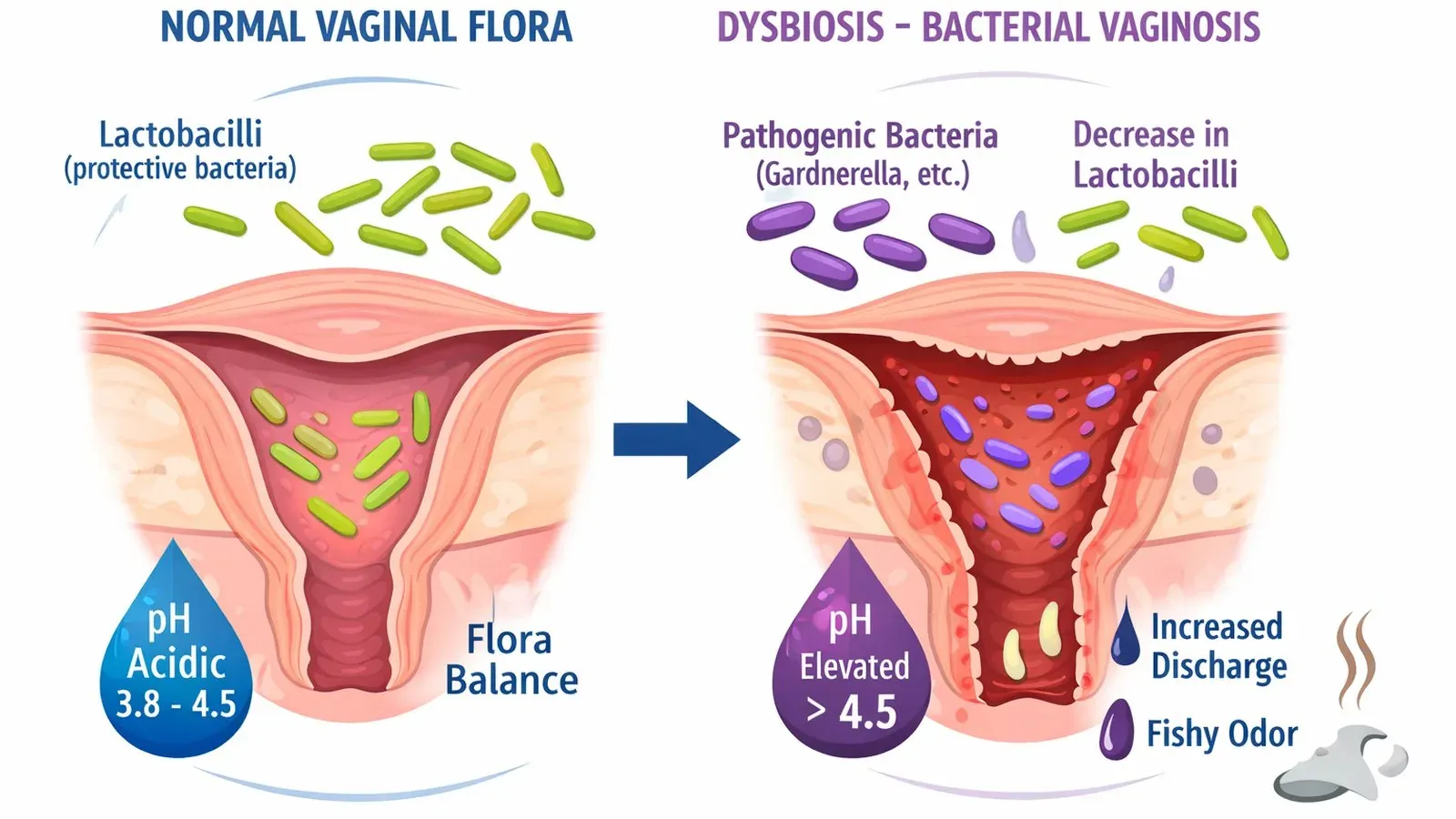
A lactobacillus-rich vaginal ecosystem may include species such as Lactobacillus crispatus, L. jensenii, and L. gasseri. They contribute to lactic-acid production and an acidic vaginal pH, commonly between 3.8 and 4.5 in reproductive-age women (Liu et al. 2025).
This environment can help:
- restrain some BV-associated anaerobic bacteria,
- produce metabolites and antimicrobial substances that shape the microbial community,
- support the local mucosal environment.
This microbial environment is not static. It naturally fluctuates across the menstrual cycle, during pregnancy, after intercourse, during antibiotic use, and after menopause as systemic estrogen levels change.
What vaginitis means: signs and symptoms
Vaginitis is an umbrella clinical term for inflammation or infection of the vagina. It is not a single disease, but rather a clinical presentation that can stem from several distinct causes (ACOG Practice Bulletin No. 215).
Common symptoms include:
- a noticeable change in the color, volume, or consistency of vaginal discharge,
- persistent vulvar or vaginal itching, burning, soreness, or redness,
- an unpleasant, stale, or fishy odor,
- discomfort or sharp pain during sexual intercourse (dyspareunia),
- burning during urination (dysuria), often felt on the inflamed external skin.
Different conditions can feel very similar. Symptoms alone often cannot identify the cause, which is why a careful history and appropriate testing matter.
Common causes: from dysbiosis to infections
Common causes considered during an assessment include:
- Bacterial vaginosis (BV): The most common cause of vaginal discharge in women of reproductive age. Rather than an infection by a single foreign pathogen, BV represents a complex dysbiosis: protective lactobacilli diminish, allowing a diverse consortium of anaerobes (Gardnerella vaginalis, Atopobium vaginae, Prevotella) to multiply. It typically produces a thin, watery, grayish-white discharge and a distinct fishy amine odor, with a vaginal pH above 4.5.
- Vulvovaginal candidiasis (yeast infection): An overgrowth of Candida fungi (most commonly Candida albicans). It typically causes intense vulvar pruritus, burning, erythema, and a thick, white, clumpy discharge resembling cottage cheese. Crucially, the vaginal pH in uncomplicated yeast infections remains normal (≤ 4.5).
- Trichomoniasis: A common sexually transmitted infection caused by the protozoan Trichomonas vaginalis. Symptoms can range from mild irritation to profuse, frothy, yellow-green discharge, a strong odor, vulvar swelling, and cervical punctate hemorrhages (“strawberry cervix”). Vaginal pH is elevated (> 4.5).
- Genitourinary syndrome of menopause (atrophic vaginitis): When circulating estrogen drops significantly—most commonly after menopause, but also during prolonged breastfeeding or anti-estrogenic medical therapy—the vaginal mucosa thins, glycogen drops, lactobacilli decline, and pH rises. This leads to dryness, irritation, and discomfort without an active infection.
- Non-infectious contact dermatitis or irritation: Chemical irritants (scented washes, douches, latex condoms, lubricants, laundry detergents) can cause vulvovaginal burning and redness that mimic an infection, even though cultures and swabs are completely clear.
For a detailed side-by-side comparison of the two most common conditions, explore our guide on discharge, itching, or odor: yeast infection or bacterial vaginosis?.
Why accurate diagnosis beats guessing
It is understandable to reach for an over-the-counter antifungal when itching starts. But if the cause is bacterial vaginosis, trichomoniasis, or irritation, that treatment will not address it and may delay the right assessment.
An in-clinic assessment combines the history and examination with one or more tests. No single finding answers every case (CDC vaginal discharge guidance):
- Vaginal pH testing: A pH above 4.5 is common with BV or trichomoniasis, whereas uncomplicated candidiasis usually occurs with a normal pH. pH is a clue, not a diagnosis; trichomoniasis can also occur with a normal pH.
- Wet mount microscopy: Direct examination may show clue cells, yeast forms, or motile trichomonads. A negative wet mount does not rule out yeast or trichomoniasis because microscopy has limited sensitivity.
- Whiff test: Adding a drop of 10% potassium hydroxide (KOH) releases a sharp fishy odor in BV.
- Validated molecular testing: NAATs can help detect Trichomonas, identify Candida species, or assess BV-associated bacterial patterns when indicated. BV NAATs are intended for symptomatic women; detecting an organism does not always mean it is causing the symptoms.

What a “shift in flora” or a Gardnerella result really means
Seeing “shift in vaginal flora” or “Gardnerella vaginalis detected” on a report can be worrying. It is not a diagnosis by itself.
A positive Gardnerella culture or molecular result is not synonymous with bacterial vaginosis. The organism can be detected without symptoms, and the CDC does not recommend G. vaginalis culture as a diagnostic test because it is not specific. BV molecular tests should be used for symptomatic women (CDC bacterial vaginosis guidance).
BV can be diagnosed with at least three of the four Amsel criteria (homogeneous thin discharge, vaginal pH above 4.5, a positive whiff test, and clue cells on microscopy) or with a Nugent score of 7 to 10 on a Gram-stained smear.
Dr. Aksoy’s clinical perspective: A laboratory report helps with diagnosis; it does not prescribe the treatment. If a patient has no symptoms and the examination does not support infection, an isolated organism name may not need antibiotics. The result has to be interpreted with the clinical picture. We treat the patient in front of us, not the paper report.
Do sexual partners require treatment?
Partner management depends strictly on the confirmed diagnosis:
- Trichomoniasis: Because this is a sexually transmitted pathogen, current sexual partners must be treated simultaneously, and sexual intercourse should be avoided until both partners complete therapy and symptoms resolve (CDC trichomoniasis guidance).
- Uncomplicated yeast infections: Routine partner treatment is not indicated, as candidiasis is not considered a sexually transmitted disease.
- Bacterial vaginosis: Older CDC guidance does not recommend routine partner treatment. A 2025 randomised trial found fewer recurrences when male partners received concurrent oral and topical treatment (Vodstrcil et al. 2025). Guidance is evolving, so partner treatment is a clinician-led option for selected recurrent cases, not a step to start independently.
Treatment depends on the confirmed cause
Treatment depends on the confirmed or most likely cause. The regimens below are guideline examples, not instructions for self-treatment:
- Bacterial vaginosis: CDC regimens include oral metronidazole, intravaginal metronidazole gel, or intravaginal clindamycin cream; the appropriate option depends on pregnancy, tolerance, interactions, and the clinical setting (CDC BV guidance). The CDC notes that evidence does not support a disulfiram-like alcohol interaction with metronidazole, although patients should follow their own prescriber’s and product-label instructions.
- Yeast infection (candidiasis): Treatment may include a topical azole or, for selected nonpregnant patients, oral fluconazole. Important pregnancy safety note: During pregnancy, CDC guidance recommends only a 7-day course of topical azole therapy under clinical supervision; oral fluconazole should not be used (CDC candidiasis guidance).
- Trichomoniasis: Oral nitroimidazole treatment is required, together with treatment of current partners; the exact regimen should be prescribed clinically.
- Genitourinary syndrome of menopause: Vaginal moisturisers or local hormonal treatment may be considered after an individual assessment.
- Contact irritation: Removing the suspected irritant is the first step. Persistent or severe symptoms need examination because infection and skin conditions can look similar.
Impact on fertility, IVF, and pregnancy
An uncomplicated yeast infection is not known to damage the fallopian tubes. BV, particularly when symptomatic during pregnancy, deserves clinical attention:
- During pregnancy: Symptomatic BV is associated with adverse outcomes including premature rupture of membranes and preterm birth, and symptomatic pregnant women should be assessed and treated (CDC BV guidance). Routine screening of asymptomatic pregnant women, including those at higher risk of preterm birth, is not recommended by the CDC because trial results are mixed.
- During IVF and embryo transfer: Some observational studies associate a Lactobacillus-dominant vaginal microbiome with better IVF outcomes, but they do not show that the vaginal profile causes implantation success. ESHRE does not recommend routine vaginal or endometrial microbiome profiling after recurrent implantation failure.
- Upper genital tract health: Vaginal dysbiosis is different from chronic endometritis. A vaginal swab does not diagnose inflammation inside the uterus; suspected chronic endometritis requires its own targeted assessment.
Practical daily care for vaginal health
Simple habits can reduce irritation without promising to “optimise” a microbiome result:
- Wash the external vulva only: Use warm water alone or a mild, unscented, soap-free cleanser (syndet). Never wash or spray water inside the vaginal canal; the vagina is naturally self-cleansing.
- Avoid vaginal douching: It is associated with BV and can increase the risk of recurrence; it is not a treatment for discharge or odour.
- Reduce prolonged moisture and friction: Change out of damp clothing if it is causing irritation; there is no special fabric that guarantees protection from vaginitis.
- Use antibiotics only when prescribed: Antibiotics can alter the vaginal microbiota, so they should be used for a clear clinical indication.
Frequently Asked Questions
Can my symptoms alone tell me which infection I have?
No. Discharge, itching, burning, and odour overlap across BV, candidiasis, trichomoniasis, cervicitis, and non-infectious irritation. A history, examination, and appropriate tests—sometimes including pH, microscopy, culture, or NAAT—help identify the cause.
Is bacterial vaginosis considered an STI?
Not in the same way as a classic STI. Bacterial vaginosis is a vaginal dysbiosis, but sexual activity and partner-related factors can influence risk, and research on transmission is still evolving. BV can also occur without recent sexual activity.
Can you have a yeast infection and bacterial vaginosis at the same time?
Yes. More than one condition can be present at the same time. If symptoms persist after treatment, reassessment is more useful than assuming that the first diagnosis was complete.
Why do yeast infections often develop after taking antibiotics?
Antibiotics can alter bacterial communities that normally help keep Candida in balance. That can make candidiasis more likely in some people, although not every symptom after antibiotics is a yeast infection.
When should I consult a doctor rather than trying home remedies?
Consult a healthcare provider if this is your first episode of vaginal symptoms, if you are pregnant, if you experience lower abdominal or pelvic pain, if you develop a fever, or if symptoms recur frequently or fail to clear within a few days of starting treatment.
Sources
- Centers for Disease Control and Prevention. Bacterial Vaginosis - STI Treatment Guidelines. MMWR Recomm Rep, 2021.
- Centers for Disease Control and Prevention. Vulvovaginal Candidiasis - STI Treatment Guidelines. MMWR Recomm Rep, 2021.
- Centers for Disease Control and Prevention. Trichomoniasis - STI Treatment Guidelines. MMWR Recomm Rep, 2021.
- Centers for Disease Control and Prevention. Vaginal Discharge - STI Treatment Guidelines. MMWR Recomm Rep, 2021.
- American College of Obstetricians and Gynecologists. Vaginitis in Nonpregnant Patients: ACOG Practice Bulletin No. 215. Obstet Gynecol, 2020;135(1):e1-e17. doi:10.1097/AOG.0000000000003604.
- Liu D, Zhang X, Zhao X, Che X, Song W, Wu G. Bacterial vaginosis: advancing insights into microbial dysbiosis. Crit Rev Microbiol, 2025;52(1):159-175. doi:10.1080/1040841X.2025.2537923.
- Vodstrcil LA, et al. Male-Partner Treatment to Prevent Recurrence of Bacterial Vaginosis. N Engl J Med, 2025;392(10):947-957. doi:10.1056/NEJMoa2405404.
- ESHRE Working Group on Recurrent Implantation Failure. ESHRE good practice recommendations on recurrent implantation failure. Hum Reprod Open, 2023;2023(3):hoad023.
- Sobel JD. Overview of Vaginitis. MSD Manual Professional Edition, 2024.
Add as a Preferred Source on Google
You can add draksoyivf.com as one of your preferred health information sources on Google.

The content has been created by Dr. Senai Aksoy and medically approved.