
Endometriosis Symptoms: Recognising the Signs and When to Seek Care
Key Takeaways
Endometriosis symptoms vary widely and are often linked to the menstrual cycle, commonly presenting as progressive dysmenorrhoea, chronic pelvic pain, deep dyspareunia, cyclic bowel or bladder pain, and difficulty conceiving. Symptom severity does not always mirror anatomical lesion extent, and a normal standard ultrasound does not exclude the condition. Recognising red flags—especially possible organ involvement or disabling pain in adolescents—can help prompt appropriate assessment; reported diagnostic delays vary across studies from 0.3 to 12 years.
Key evidence: ESHRE Guideline: Endometriosis (2022) Diagnostic Delay in Endometriosis (BJOG 2025) NICE Guideline NG73: Endometriosis (2024)
A highly variable presentation
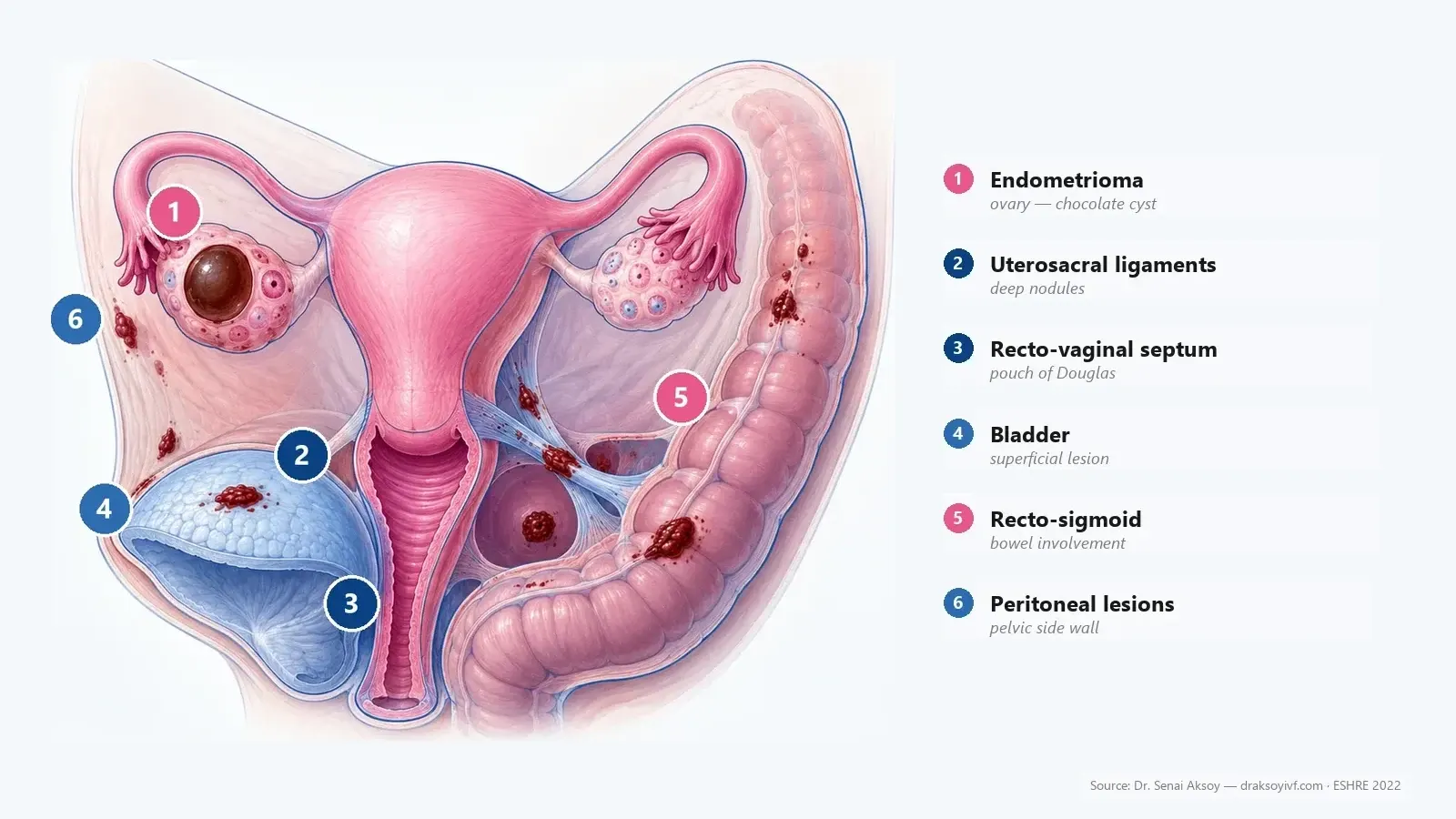
Endometriosis manifests with substantial clinical variability from one patient to another. Some women experience debilitating pelvic pain despite small, superficial peritoneal implants, while others have extensive deep infiltrating lesions or large ovarian endometriomas discovered incidentally during routine fertility workups.
Crucially, symptom severity does not always correlate with lesion extent. Understanding this disconnect helps prevent both underdiagnosis and unnecessary panic. Recognising these patterns can help someone seek an appropriate assessment sooner, but symptoms alone cannot predict disease extent or future fertility.
For a broader overview of diagnostic pathways and long-term care, visit our guide on diagnosing endometriosis and our complete endometriosis guide.
Cardinal symptoms
While symptoms fluctuate throughout life, the following symptoms are commonly associated with endometriosis:
Progressive Dysmenorrhoea
Pain that worsens over successive months or years can be a warning sign. Primary dysmenorrhoea is common in teenagers and often improves with standard anti-inflammatory medicines; endometriosis-related pain may become more persistent or harder to control. These patterns are not diagnostic on their own.
Chronic Pelvic Pain
Constant or intermittent aching deep in the lower abdomen or pelvis occurring outside the menstrual window. Over months and years, persistent local inflammation can trigger peripheral and central pain sensitisation, meaning the nervous system amplifies pain signals even during non-bleeding phases of the cycle.
Deep Dyspareunia
Pain felt deep within the pelvis during or after sexual intercourse can occur with endometriosis, including deep disease involving the uterosacral ligaments, the posterior vaginal fornix, or the rectovaginal septum. It can also have other causes, so it should prompt assessment rather than be treated as a diagnosis.
Dyschezia & Gastrointestinal Symptoms
Painful bowel movements, rectal cramping, or painful straining that intensifies during menstruation. Patients may notice cyclic abdominal bloating, painful diarrhoea, or constipation around their periods. Cyclic rectal bleeding, though less common, should prompt assessment for possible bowel involvement.
Dysuria & Urinary Symptoms
Pain, pressure, or burning when urinating during menstrual periods. Cyclic urinary urgency or blood in the urine should prompt assessment for possible urinary-tract involvement; symptoms alone cannot identify the exact site.
Subfertility & Infertility
Endometriosis is associated with difficulty conceiving. The World Health Organization reports that endometriosis is found in as many as 25% to 50% of women experiencing infertility. Inflammation, adhesions, altered tubal function, and other fertility factors may all contribute.
Chronic Fatigue & Systemic Malaise
Persistent, unrefreshing exhaustion is widely reported by patients. Fatigue may be related to pain, disrupted sleep, heavy bleeding, iron deficiency, or the wider burden of living with a chronic condition. It is not specific to endometriosis and deserves its own assessment.
Atypical presentations to keep in mind
Not all endometriosis symptoms reside neatly in the lower pelvis:
- Extra-pelvic lesions: Cyclic shoulder or upper right quadrant pain can occur with diaphragmatic endometriosis. Cyclic shortness of breath or chest pain can occur with thoracic endometriosis; sudden chest pain or breathlessness needs urgent medical assessment. The ESHRE guideline lists these as symptoms clinicians should recognise.
- Asymptomatic disease: Disease may remain entirely silent until revealed during laparoscopic investigation or routine reproductive imaging.
- Overlapping visceral conditions: Symptoms are sometimes attributed to irritable bowel syndrome (IBS), recurrent urinary tract infections, or interstitial cystitis, which can send people through separate gastroenterology and urology pathways.
Clinical examination
A detailed physical examination conducted by an experienced gynaecologist can provide useful clues:
- Localised tenderness or nodularity along the uterosacral ligaments during bimanual examination.
- Palpable, tender nodules in the posterior vaginal fornix or rectovaginal septum.
- A fixed, retroverted uterus resulting from posterior pelvic adhesions.
- Palpable, tender adnexal masses consistent with ovarian endometriomas.
A completely normal physical examination does not rule out endometriosis, particularly superficial peritoneal disease or early-stage lesions.
Endometriosis in adolescents: why early signs are missed
Severe menstrual pain in teenagers that leads to repeated school absence, emergency department visits, or regular reliance on pain medicine should not be dismissed as “just normal period pain”.
In adolescents, severe symptoms can be overlooked or dismissed for too long. The ESHRE 2022 guideline supports discussing symptom treatment and further assessment rather than making diagnostic laparoscopy the automatic first step:
- The ESHRE guideline supports offering hormonal treatment such as a combined hormonal contraceptive or a progestogen for symptom control, without making immediate diagnostic laparoscopy the automatic first step.
- If symptoms persist despite treatment or the diagnosis remains uncertain, a specialist team can discuss whether laparoscopy is appropriate, taking future reproductive goals into account.
The diagnostic delay: a global problem
The contemporary systematic literature review by De Corte et al. (2025) found that reported times from symptom onset to diagnosis ranged from 0.3 to 12 years, with estimates varying by definition, region, and study population. This variation is one reason a single worldwide average can be misleading.
Key drivers of this delay include:
- Normalisation of menstrual pain: Societal and clinical dismissal of dysmenorrhoea as an unavoidable part of female physiology.
- Fragmented care: Disjointed referrals between primary care, gastroenterology, and urology without unified gynaecological coordination.
- False reassurance from routine scans: A non-specialist pelvic ultrasound may not detect superficial implants or subtle deep nodules.
Specialist transvaginal ultrasound using the IDEA (International Deep Endometriosis Analysis) approach and pelvic MRI can help map deep disease and guide referral or treatment planning. The IDEA consensus standardises how the ultrasound assessment is described; a normal scan still does not exclude superficial disease.
Dr. Aksoy’s clinical perspective
Dr. Aksoy’s Approach: Assessing Pelvic Pain & Organ Risk
“When assessing chronic pelvic pain or severe period cramps, pain scores alone do not determine the clinical roadmap. Two factors often shape my approach: the risk of organ involvement and the patient’s timeline for pregnancy.
If red-flag signs emerge—such as cyclic pain or bleeding with bowel movements or urination, deep pain during intercourse, a fixed retroverted uterus, palpable nodules, or imaging suggesting ureteral compression, hydronephrosis, or bowel infiltration—I recommend prompt specialist assessment and expert imaging. If organ involvement is confirmed or strongly suspected, multidisciplinary planning may be needed. Organ function must be protected.
In contrast, when there is no evidence of organ involvement and pregnancy is not an immediate goal, a clinician may discuss hormonal treatment for pain. The choice depends on contraindications, side effects, preferences, and reproductive goals; a normal ultrasound still does not rule out endometriosis.
If pregnancy is the immediate goal, age, ovarian reserve (AMH/AFC), tubal patency, sperm parameters, prior surgeries, and lesion location guide the discussion of trying to conceive, surgery, or IVF. Hormonal suppression alone does not improve spontaneous pregnancy rates.
Finally, sudden severe pain, fever, or a rapidly enlarging mass needs urgent medical assessment rather than routine chronic-pain follow-up.”
— Dr. Senai Aksoy
Warning signs that warrant consultation
Seek medical evaluation if you experience:
- Period pain that progressively worsens over time or fails to respond to standard anti-inflammatory medications.
- Deep pelvic pain during or after sexual intercourse.
- Bowel pain (dyschezia) or urinary pain (dysuria) that coincides with your menstrual cycle.
- Rectal bleeding or visible blood in the urine during your period.
- Difficulty conceiving after 12 months of unprotected intercourse (or after 6 months if aged 35 or older). Suspected endometriosis or another known risk factor may justify an earlier fertility assessment.
- Severe, disabling period pain in an adolescent causing school absenteeism.
Preparing for your appointment with a menstrual and symptom diary can help you and your clinician see patterns in pain, cycle timing, and functional limitations. It supports the medical history but does not diagnose endometriosis on its own.
Practical summary
- Recognise progressive symptoms: Escalating dysmenorrhoea, deep dyspareunia, cyclic bowel or bladder pain, and difficulty conceiving are signs that should raise suspicion of endometriosis.
- Normal tests do not exclude disease: Standard physical exams and routine ultrasounds often miss superficial or early peritoneal lesions.
- Act early in adolescents: Disabling menstrual pain in teenagers deserves early medical assessment and a discussion of symptom-relief options.
- Differentiate pain relief from fertility care: Hormonal treatment can reduce pain, but fertility planning may require a tailored reproductive strategy based on age, ovarian reserve, tubal factors, sperm parameters, and the person’s goals.
FAQ
Are all painful periods suggestive of endometriosis?
No. Primary dysmenorrhoea is common in adolescents and often improves with standard anti-inflammatory medicines. Warning signs that justify assessment include pain that progressively intensifies, becomes harder to control, or occurs alongside deep dyspareunia, dyschezia, dysuria, or difficulty conceiving.
Can you have endometriosis without experiencing pain?
Yes. Some women with endometriosis are completely asymptomatic and discover their condition incidentally during an infertility workup, an ultrasound for an unrelated reason, or during unrelated pelvic surgery. The anatomical extent of endometriosis lesions does not always match the severity of pain symptoms.
Is endometriosis pain “all in my head”?
No. Endometriosis pain is real and can be driven by inflammation, lesions, pelvic-floor changes, and nervous-system sensitisation. Stress, anxiety, and the emotional burden of chronic pain can also affect how pain is experienced; that does not make the pain imaginary or “all in your head”.
My 16-year-old daughter has severe menstrual cramps. When should we seek specialist care?
If menstrual pain causes her to miss school, require regular pain medicine, last several days each cycle, or lead to emergency medical attention, she should be evaluated promptly. ESHRE supports discussing hormonal treatment, such as a combined hormonal contraceptive or a progestogen, with a clinician rather than waiting automatically for laparoscopic confirmation.
Which healthcare provider should I see first?
If possible, consult a gynaecologist with specialised training in endometriosis and advanced pelvic ultrasound. Alternatively, your primary care physician can initiate basic investigations and coordinate referral for specialist pelvic imaging where appropriate. Avoiding fragmented pathways between separate specialists without gynaecological leadership may reduce diagnostic delay.
What documents and records should I bring to my consultation?
Bring any previous pelvic ultrasound and MRI reports or imaging discs, operative reports, a current medication list, and a symptom diary documenting cycle days, pain intensity, and functional impact. If you already have hormone tests or a semen analysis, bring those too; they are not all required for every symptom assessment.
Sources
- Becker CM, Bokor A, Heikinheimo O, et al. ESHRE guideline: endometriosis. Human Reproduction Open 2022;2022(2):hoac009.
- De Corte P, Klinghardt M, von Stockum S, Heinemann K. Time to diagnose endometriosis: current status, challenges and regional characteristics—a systematic literature review. BJOG 2025;132(2):118–130. doi:10.1111/1471-0528.17973.
- National Institute for Health and Care Excellence. Endometriosis: diagnosis and management (NICE guideline NG73). Updated 2024.
- World Health Organization. Endometriosis Fact Sheet. 2025.
- Guerriero S, Condous G, van den Bosch T, et al. Systematic approach to sonographic evaluation of the pelvis in women with suspected endometriosis: IDEA consensus opinion. Ultrasound in Obstetrics & Gynecology 2016;48(3):318–332. doi:10.1002/uog.15955.
Add as a Preferred Source on Google
You can add draksoyivf.com as one of your preferred health information sources on Google.

The content has been created by Dr. Senai Aksoy and medically approved.