
Frozen Embryos in IVF: When Freezing Helps and What the Tradeoffs Are
Key Takeaways
Embryo freezing via vitrification allows embryos to be safely preserved and transferred in a separate cycle when the uterine lining is optimal. A freeze-all approach is particularly beneficial for high responders, those at risk for OHSS, cycles with elevated progesterone, or when genetic testing is planned. For normal responders with a healthy endometrium, cumulative live birth rates are comparable between fresh and frozen transfers, making protocol individualization essential.
Key evidence: Cochrane Systematic Review — Fresh vs Frozen Embryo Transfers (2021) Human Reproduction Update — Elective Frozen vs Fresh Transfer Meta-Analysis (2019) ASRM Practice Committee — Fresh and Frozen Transfers Committee Opinion (2021)
Fresh vs Frozen Embryo Transfer in IVF: How to Choose
This video was recorded in French. Check the YouTube player settings for any translated audio or subtitles available for this video.
On this page
- How embryo freezing works
- Why embryos are frozen: key clinical indications
- Clinical advantages of frozen embryo transfer
- Dr. Aksoy’s clinical perspective
- Tradeoffs and realistic considerations
- What the clinical evidence shows
- Preparing for a frozen transfer cycle
- Related reading
- Frequently asked questions
- Sources
Frozen Embryos in IVF: An Evolving Standard
Embryo cryopreservation is no longer merely a backup plan for surplus embryos. In modern assisted reproductive technology, frozen embryo transfer (FET) is a primary clinical strategy that allows doctors to separate the ovarian stimulation phase from the uterine implantation phase.
This clinical shift became possible due to vitrification—an ultra-rapid flash-freezing method that virtually eliminates ice crystal formation. Today, post-thaw embryo survival rates routinely exceed 95% in experienced embryology laboratories (Rienzi et al., 2017).
However, deciding whether to freeze all embryos or proceed with a fresh transfer requires evaluating individual clinical factors rather than defaulting to a universal policy.
How Embryo Freezing Works
Short Answer:
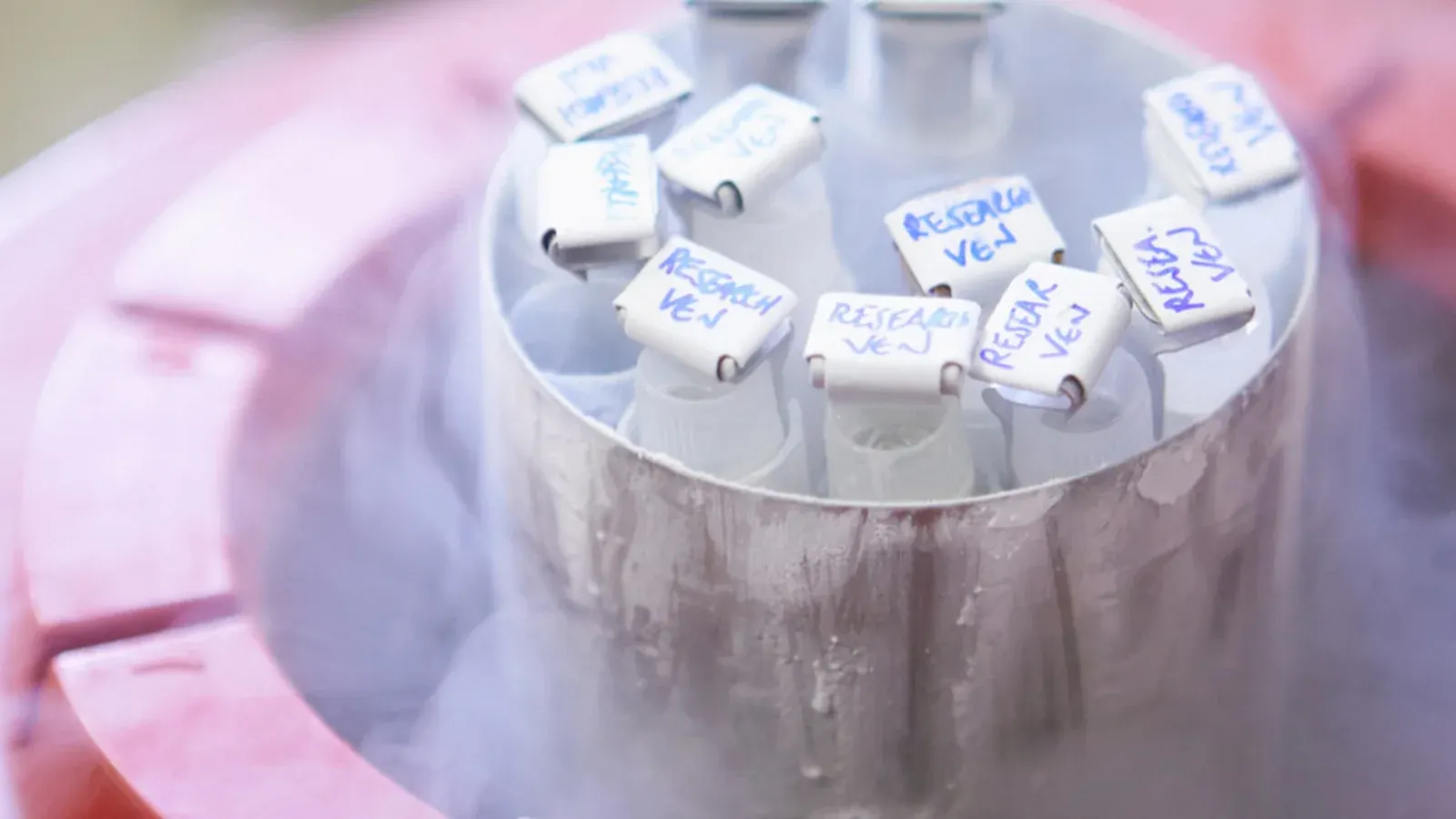
Embryos are cultured to the blastocyst stage (day 5 or 6), treated with protective cryoprotectant solutions, and flash-frozen in liquid nitrogen at -196°C to preserve cellular structure until transfer.
Ovarian Stimulation & Retrieval
               │
               ▼
   Fertilization (IVF / ICSI)
               │
               ▼
   Extended Culture to Day 5/6 (Blastocyst)
               │
               ▼
   Vitrification (Ultra-Rapid Freezing)
               │
               ▼
   Storage in Liquid Nitrogen (-196°C)
               │
               ▼
   Thawing & Assessment Before Transfer
During vitrification, water inside the embryonic cells is rapidly drawn out and replaced with specialized cryoprotectants. The embryo is then submerged into liquid nitrogen within milliseconds. This avoids the mechanical cell membrane damage historically associated with older, slow-freezing protocols.
At -196°C, all metabolic and biological processes cease entirely. Embryos can remain cryopreserved for years or even decades without degrading their developmental potential or increasing chromosomal abnormality rates.
Why Embryos Are Frozen: Key Clinical Indications
Short Answer:
Embryos are frozen primarily to eliminate the risk of ovarian hyperstimulation syndrome (OHSS), avoid transferring into a hormonally hostile uterine lining, allow time for genetic testing, or bank embryos for future children.
- Reducing ovarian hyperstimulation syndrome (OHSS) risk: In patients at high risk, avoiding an immediate pregnancy can reduce late-onset OHSS. A freeze-all plan is one part of a broader prevention strategy; it does not eliminate risk in every case (ESHRE Guideline).
- A possible shift in endometrial timing: Some studies use progesterone values such as 1.5 ng/mL as a reference, but there is no universal pass-or-fail threshold. The result must be interpreted with the assay, ovarian response and clinic protocol in view (Roque et al., 2019).
- Preimplantation Genetic Testing (PGT): When embryos undergo trophectoderm biopsy on day 5 or 6 for chromosomal screening (PGT-A) or monogenic disorders (PGT-M), freezing is necessary while awaiting genetic sequencing results.
- Suboptimal Endometrial Conditions: If cycle monitoring reveals an unexpected uterine polyp, fluid within the endometrial cavity, or an abnormally thin lining, freezing the embryos allows the clinical team to perform corrective interventions (like hysteroscopy) before attempting transfer.
- Preserving Reproductive Potential for the Future: When an IVF cycle yields multiple high-grade blastocysts, cryopreservation enables patients to attempt second or third pregnancies years later without repeating ovarian stimulation or egg retrieval.
Clinical Advantages of Frozen Embryo Transfer
Short Answer:
Frozen transfer allows the uterus to return to a natural, physiological state, creating an optimal hormonal environment for implantation without the stress of ovarian stimulation.
- Physiological Hormone Levels: Ovarian stimulation produces supraphysiological estrogen and progesterone concentrations. Decoupling egg collection from transfer allows the endometrial lining to be prepared in a calm, controlled cycle.
- Flexible Scheduling and Monitoring: A frozen transfer can be timed precisely to patient readiness and clinical convenience, avoiding the strict, time-pressured deadlines of an active retrieval cycle.
- Improved Perinatal Outcomes in Selected Groups: Large cohort analyses indicate that singleton pregnancies resulting from frozen embryo transfers have lower rates of low birth weight and small-for-gestational-age infants compared to fresh IVF transfers (Maheshwari et al., 2018).
Dr. Aksoy’s clinical perspective
“One of the greatest advancements in reproductive medicine over the last two decades is that we are no longer forced to transfer an embryo into an exhausted, hyperstimulated body. Vitrification gives us the freedom to pause.
“If your progesterone rises prematurely on the day of your trigger, or if your ovaries produced twenty eggs, your uterus is simply not in its best state to welcome an embryo. In those moments, freezing everything is not a setback; it is an active medical strategy that protects your safety and preserves your highest chance of pregnancy.
“At the same time, we do not believe in universal freezing for every single patient. If you have a normal response, a beautifully synchronized trilaminar endometrium, and stable hormone levels, a fresh blastocyst transfer remains an excellent, evidence-based option that avoids unnecessary delays. As with everything in fertility care, the right choice is the one tailored to your specific cycle.”
— Dr. Senai Aksoy
Tradeoffs and Realistic Considerations
Short Answer:
Frozen embryo transfers introduce treatment delays, additional storage or thawing fees, and specific obstetric risk profiles that require careful protocol selection.
While frozen embryo transfer offers substantial advantages, it is not without tradeoffs that patients should weigh carefully:
| Consideration | Clinical Implication | How We Manage It |
|---|---|---|
| Treatment Delay | Requires waiting at least one full menstrual cycle after egg retrieval before transfer. | Allows physical recovery and systemic hormonal normalization. |
| Thaw Survival Risk | A small fraction (less than 5%) of embryos may not survive the thawing process. | We freeze only robust, high-quality blastocysts using verified vitrification protocols. |
| Logistics and Cost | Involves cryopreservation, annual storage maintenance, and FET cycle fees. | Transparent, structured planning provided before starting treatment. |
| Obstetric Profile | Programmed (HRT) FET cycles without a corpus luteum carry a slightly higher risk of preeclampsia and large-for-gestational-age infants (Maheshwari et al., 2018). | Where ovulatory function is regular, we prefer natural or modified natural FET protocols to preserve corpus luteum vascular support. |
For international patients traveling to Istanbul, freezing embryos also impacts travel itineraries. Many patients choose a two-visit strategy: one week for egg retrieval and freezing, followed by physical recovery at home, and a shorter second trip for the frozen embryo transfer. Our IVF in Turkey guide and how to plan IVF abroad guide detail these travel logistics.
What the Clinical Evidence Shows
Short Answer:
Systematic reviews demonstrate clear live birth improvements with freeze-all in high ovarian responders, while cumulative pregnancy rates between fresh and frozen transfers remain equivalent in normal responders.
Rigorous Cochrane systematic reviews and ASRM Practice Committee opinions provide clear clarity on who benefits most from embryo freezing:
- High responders and PCOS: Freeze-all may reduce OHSS in patients at high risk, but the size of any live-birth advantage depends on the population and outcome measured (Roque et al., 2019; Zaat et al., 2021).
- Normal Responders: In women with an average ovarian response (typically 6 to 14 eggs retrieved), cumulative live birth rates across all embryos are statistically equivalent whether the first transfer is fresh or frozen (Zaat et al., 2021; ASRM Practice Committee, 2021).
- Poor Responders: Elective freeze-all does not improve pregnancy rates in low ovarian responders and may unnecessarily prolong time to pregnancy unless an independent uterine indication exists.
Preparing for a Frozen Transfer Cycle
Endometrial preparation aims to synchronise the lining with the embryo. Thickness and ultrasound pattern are considered alongside the full clinical picture; 7–8 mm is not a universal pass-or-fail threshold.
Depending on ovulatory regularity, three main protocols are utilized (Hsueh et al., 2023):
- Natural Cycle FET: Relies on the patient’s own natural ovulation and corpus luteum formation, requiring minimal medication and carrying favorable maternal vascular outcomes.
- Modified Natural Cycle FET: Combines spontaneous follicular growth with an hCG trigger shot to pinpoint ovulation timing precisely.
- Programmed (Hormone Replacement Therapy) FET: Uses oral or transdermal estrogen to build the lining, followed by progesterone supplementation to open the implantation window. This is ideal for patients with irregular cycles or ovulatory dysfunction.
For an in-depth breakdown of medication schedules and cycle choices, explore our guide on preparing the endometrium for frozen embryo transfer.
Related Reading
- Fresh vs Frozen Embryo Transfer: How Doctors Choose
- Preparing the Endometrium for Frozen Embryo Transfer: HRT, Natural, and Hybrid Cycles
- Embryo Transfer Timing in IVF: When Day 3 or Day 5 Makes More Sense
- How to Plan IVF Abroad: Step-by-Step Logistics and Scheduling
Frequently Asked Questions
Do frozen embryos have the same success rate as fresh embryos?
Yes, and in specific patient groups, frozen embryos yield higher pregnancy rates. In high responders or cycles with elevated progesterone, frozen transfers outperform fresh transfers because the uterine lining is more receptive. In normal responders, cumulative pregnancy rates across the whole cycle are equivalent.
How long can frozen embryos remain safely stored?
At liquid-nitrogen temperatures, biological activity is effectively suspended. Long-storage birth reports are reassuring, but legal limits, consent renewal and clinic policy vary; storage duration should be discussed with the clinic.
What is the risk of an embryo not surviving the thaw?
Modern vitrification often has high warming-survival rates in experienced laboratories, but the result varies by laboratory and embryo. The embryologist checks re-expansion and appearance after warming before transfer.
Is frozen embryo transfer painful?
Most patients describe a frozen transfer as brief, with discomfort varying by speculum use, cervical sensitivity and bladder fullness. Anaesthesia is not usually needed, but tell the team if examinations are painful or difficult.
Does embryo freezing increase the risk of birth defects?
Extensive global health registry data confirms that children conceived from vitrified frozen embryos have birth defect rates comparable to those conceived through fresh IVF or natural conception. Some studies show lower rates of preterm birth in frozen transfers, though programmed cycles require monitoring for maternal blood pressure.
Sources
- ASRM Practice Committee. “Comparison of fresh and frozen embryo transfers: a committee opinion.” Fertility and Sterility, 2021; 116(3):e65–e73. DOI
- ESHRE Guideline Group on Ovarian Stimulation. “ESHRE guideline: ovarian stimulation for IVF/ICSI.” Human Reproduction Open, 2020; 2020(2):hoaa009. PubMed
- Hsueh YW, et al. “Finding of the optimal preparation and timing of endometrium in frozen-thawed embryo transfer: a literature review of clinical evidence.” Frontiers in Endocrinology, 2023; 14:1248037. PubMed
- Maheshwari A, et al. “Obstetric and perinatal outcomes in singleton pregnancies resulting from the transfer of frozen thawed versus fresh embryos generated through in vitro fertilization treatment: a systematic review and meta-analysis.” Fertility and Sterility, 2018; 110(3):438-448. PubMed
- Rienzi L, et al. “Embryo development and cryopreservation: lessons from vitrification.” Human Reproduction, 2017; 32(6):1055-1066. PubMed
- Roque M, et al. “Fresh versus elective frozen embryo transfer in IVF/ICSI cycles: a systematic review and meta-analysis of reproductive outcomes.” Human Reproduction Update, 2019; 25(1):2-14. PubMed
- Roque M, et al. “Fresh embryo transfer versus frozen embryo transfer in in vitro fertilization cycles: a systematic review and meta-analysis.” Fertility and Sterility, 2013; 99(1):156-162. PubMed
- Zaat T, et al. “Fresh versus frozen embryo transfers in assisted reproduction.” Cochrane Database of Systematic Reviews, 2021; 2:CD011184. PubMed
Add as a Preferred Source on Google
You can add draksoyivf.com as one of your preferred health information sources on Google.

The content has been created by Dr. Senai Aksoy and medically approved.